The Private Self and Solitude
To the LighthouseThe Private Self and Solitude describes the inward life Mrs Ramsay reaches when she is temporarily released from caring for others. Her solitude is not simply withdrawal: it is a way of being that lets her shed the familiar roles through which others recognize her, and encounter a self she experiences as deep, unbounded, and largely inaccessible. The Lighthouse beam, watched while she knits, becomes both an external object of attention and a measure of this private consciousness—steady enough to gather her thoughts, yet remorselessly separate from her.
The Self Beneath Social Appearances
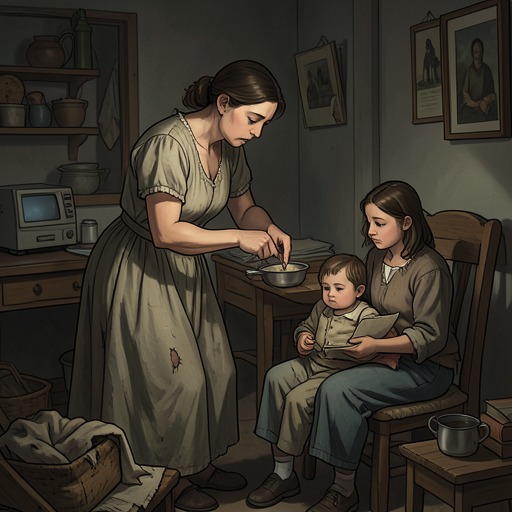
After James has been carried away, Mrs Ramsay turns to the pictures he has cut out: a refrigerator, a mowing machine, and a gentleman in evening dress. His disappointment at not going to the Lighthouse tomorrow has made her think about how much children remember, and how important words and actions are. When the children have gone to bed, however, the responsibility of attending to anyone else briefly lifts. She can be herself, by herself; what she wants is not even necessarily thought, but silence and aloneness.
The change is rendered as a shedding of social presence. The expansive, glittering, vocal business of being and doing evaporates, leaving what she calls a wedge-shaped core of darkness: invisible to other people, yet free for strange adventures. This inwardness is not presented as a hidden store of settled opinions. It is a depth that ordinary appearances cannot disclose. Mrs Ramsay imagines that she, Lily Briscoe, and Augustus Carmichael are each known by outward apparitions that are merely childish in comparison with what lies beneath them. People surface into view in partial forms; the darkness under those forms spreads beyond what another person can grasp.
Solitude therefore gives Mrs Ramsay a sense of spaciousness rather than mere deprivation. Her horizon seems limitless, extending in imagination to the Indian plains and to a church in Rome, whose thick leather curtain she imagines pushing aside. The passage moves from the confined evening scene and her knitting to places she has never seen. That movement makes the private self feel capable of adventures beyond the visible life by which others identify her, even while she remains seated among the ordinary things of the household.
Knitting, Stillness, and the Lighthouse Beam
The knitting does not end when Mrs Ramsay turns inward. She remains upright with her work in her hands, and later holds a long reddish-brown stocking while she listens to the quiet after the children’s baths. The handwork supplies a bodily continuity to a state in which personality and its usual demands loosen. She describes rest as something found not in being oneself, but in losing the fret, hurry, and stir attached to a recognizable identity. Her needles continue moving within a scene of inward release rather than interrupting it.
At this hour she repeatedly watches the Lighthouse. Its third stroke, the long steady one, becomes especially hers: she attaches herself to it until, looking and looking, she feels that she has become the light. The identification is intimate but not simple possession. The beam can seem to express her and belong to her attention, while remaining an inanimate presence outside her. Mrs Ramsay feels that trees, streams, and flowers may express or become the solitary person who looks at them; she recognizes the tenderness of this feeling as irrational even as she experiences it.
That tension is clearest when she regards the beam as both hers and not hers, steady and pitiless, with her at its beck and call. She remembers waking at night to see it bent across the bed, stroking the floor. In the evening it falls across the waves as the daylight fades and the blue leaves the sea. The light does not explain her interior life or respond to it; its repeated, indifferent movement gives her attention something fixed to return to. Through that encounter, solitude becomes a relation to the world as well as separation from other people.
Repetition, Truth, and Uneasy Consolation
As she watches, a phrase lying in her mind rises into awareness: “Children don’t forget, children don’t forget”. She repeats it, then adds the expectation that things will end and come. A religious assertion follows: “We are in the hands of the Lord.” But she immediately resents having said it. The words do not express what she believes; she feels that she has been trapped into speaking something false. The sequence exposes a difference between a phrase that surfaces in the quiet and a conviction she can accept as her own.
The Lighthouse beam seems to meet her gaze and search her mind, purging the lie. In that image the light is not merely a soothing emblem: its scrutiny aligns with Mrs Ramsay’s own stern demand for truth. She can praise it without vanity because she recognizes in it a quality she values in herself—being searching and stern, beautiful in that severity. The private self is thus not wholly serene. Its freedom from social performance makes room for delight, but also for a close examination of what she has said and what she can honestly believe.
Her view of the world resists the consolation of a providential order. She asks how any Lord could have made a world in which there is no reason, order, or justice, but suffering, death, and the poor. No happiness lasts, and the world can commit even the basest treachery. The calmness with which she returns to knitting does not cancel these judgments. Instead, the firm work of her hands and the composed lines of her face register how she lives alongside knowledge that she cannot make comforting. When Mr Ramsay passes, he sees sternness at the heart of her beauty; her inward seriousness is visible to him, but it remains beyond his power to relieve.
Solitude, Happiness, and the Limits of Intimacy
The private state also opens onto intense happiness. Watching the beam, Mrs Ramsay feels as though its silver fingers are touching a sealed vessel in her brain; its opening would flood her with delight. As the light silver-brightens the rough waves, that expectation becomes an ecstasy in her mind. Her response culminates in the repeated declaration, “It is enough! It is enough!” The moment offers no lasting solution to the world’s suffering and no guarantee that happiness will endure. Its force lies in being complete while it lasts.
Yet solitude also makes the distance between Mrs Ramsay and her husband newly perceptible. Mr Ramsay sees her sternness and remoteness and thinks that he cannot protect her or help her; he recognizes that his irritability and his temper over the Lighthouse have made things worse. He wishes to speak when she is alone, but decides not to interrupt her. His restraint acknowledges the separateness he cannot cross, even as it leaves him sad beside the hedge.
The distance is not an absolute refusal of connection. Mrs Ramsay is accustomed to easing herself out of solitude by taking hold of some small odd or end, a sound or sight. At the end of the scene, she looks toward the light, then calls to Mr Ramsay of her own free will, takes the green shawl from the picture frame, and goes to him. She knows he wishes to protect her, but the approach is hers to make. The movement does not erase the private self or convert her inward happiness into a possession shared with him; rather, the passage sets chosen contact beside the solitude that makes her own experience possible.
Narrative Significance
The episode develops the book’s interest in the difference between outward identity and inward experience. Mrs Ramsay remains a mother at work, a wife seen by her husband, and a figure recognized by others; none of those appearances exhausts the self she encounters in silence. The narrative gives that self form through recurring attention rather than public explanation: pictures and household objects, the stocking, the needles, remembered phrases, and the Lighthouse’s returning stroke organize a consciousness that cannot be reduced to a single role.
The repeated beam also shapes the passage’s movement. Its steady return gathers scattered thought, while Mrs Ramsay’s changing responses prevent it from carrying one fixed meaning. It is hers as an object of attention and not hers as an indifferent light; it accompanies tenderness, suspicion of false consolation, awareness of suffering, and a moment of sufficient happiness. Solitude here is consequently neither simple escape nor pure isolation. It is the condition in which Mrs Ramsay can feel the depth of her own life, recognize what another person cannot reach, and still choose when to return to relation.